
Use this pine straw calculator to find how many bales you need for your beds. One bale covers about 40–50 square feet at 3 inches deep, but that number moves with the needle type, the depth, and whether you are mulching bare ground or refreshing last year’s straw — so the calculator asks for all three instead of dividing by a single fixed number.
Extra allowance, refresh rate & prices — adjust defaults
How many bales of pine straw do I need?
Divide your bed area by about 45 for longleaf straw, or about 37 for short-needle slash or loblolly straw, at the standard 3-inch depth. A 500 sq ft bed takes roughly 12 bales of longleaf or 14 of short-needle straw. Add 10% for curved edges and slopes, where straw slides and gets tucked under.
| Bed area | Longleaf | Slash / loblolly | With 10% extra |
|---|---|---|---|
| 100 sq ft | 3 bales | 3 bales | 3 / 3 |
| 250 sq ft | 6 bales | 7 bales | 7 / 8 |
| 500 sq ft | 12 bales | 14 bales | 13 / 15 |
| 1,000 sq ft | 23 bales | 28 bales | 25 / 30 |
| 2,000 sq ft | 45 bales | 55 bales | 49 / 60 |
Those counts are for a new bed at 3 inches. Refreshing last year’s straw takes about half as many, and a thinner 2-inch top-off stretches each bale further — both covered below.
Longleaf vs slash vs loblolly: why bales cover different areas
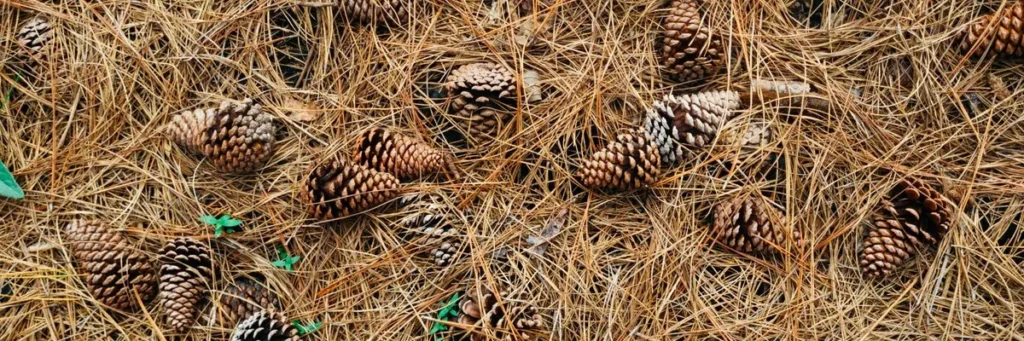
The “divide by 45” rule you see everywhere assumes longleaf straw. Longleaf needles run 8–12 inches and interlock into a loose, springy mat, so a bale typically covers 45–50 square feet at 3 inches. Slash and loblolly needles are shorter and lie flatter, so the same bale size covers closer to 35–40 square feet. On a 1,000 sq ft yard that is the difference between 23 and 28 bales — enough to send you back to the store.
| Straw | Needle length | Coverage at 3″ | Notes |
|---|---|---|---|
| Longleaf | 8–12″ | 45–50 sq ft | Premium; holds color and shape longest |
| Slash | Shorter | 35–40 sq ft | Most of the straw harvested in Georgia |
| Loblolly | Shortest | 35–40 sq ft or less | Often the cheapest bale |
Bale sizes also vary by supplier — most are around 13 × 13 × 28 inches, but some sell mini or large round bales. If your supplier prints a coverage figure on the bale or invoice, choose Custom in the calculator and use theirs.
New beds vs refreshing: you need about half
Pine straw breaks down slowly and fades over a season, so most beds get a fresh layer once a year. Because the old straw is still there underneath, a refresh usually takes 40–60% of the bales a new install would. Switch the calculator to Refresh and it uses 50% by default; raise it if last year’s layer has thinned out badly, lower it for a light color top-off.
If you find yourself needing more than about 70% of a new install, the old straw has usually rotted down into soil. At that point rake it out and treat the bed as new — layering fresh straw over a matted, damp base just traps moisture.
How deep should pine straw be?
Aim for a finished depth of 2 to 3 inches. Fresh straw is fluffy and compresses by roughly 25–30% over the first few months, so spread it a little higher than the depth you want to end up with. Go toward 3 inches for new beds, hot sun, and heavy weed pressure; 2 inches is enough for a decorative top-off.
| Finished depth | Longleaf per bale | Short-needle per bale |
|---|---|---|
| 2″ | ~56 sq ft | ~46 sq ft |
| 3″ (standard) | ~45 sq ft | ~37 sq ft |
| 4″ | ~39 sq ft | ~32 sq ft |
Coverage does not scale in a straight line with depth — loose straw spread thin still lofts — which is why a 2-inch layer only stretches a bale about 25% further, not 50%. Past 4 inches, keep straw pulled back from trunks and stems; deep mulch against bark holds moisture and invites rot and voles.
Pine straw vs mulch: cost per square foot
Bales typically sell for $4–$8 each, or $8–$15 per bale installed by a landscape crew. Spread over the area a bale covers, pine straw is usually the cheapest mulch per square foot:
| At 3″ deep | Material cost per sq ft | Lasts |
|---|---|---|
| Longleaf pine straw | $0.09–$0.18 | About a year |
| Slash / loblolly straw | $0.11–$0.22 | About a year |
| Bulk wood mulch | $0.23–$0.46 + delivery | 1–2 years |
| Bagged wood mulch | $0.38–$0.63 | 1–2 years |
The catch is lifespan: straw usually needs a refresh every year, while a good hardwood mulch can go a second season with a light top-up. Over two years the gap narrows, but straw still tends to come out ahead on cost — and it is far lighter to carry. If you are weighing the two, our mulch calculator prices out the same beds in wood mulch, and how many bags is a yard of mulch covers the bagged-versus-bulk math.
How to calculate pine straw by hand
bales = bed area (sq ft) ÷ coverage per bale × 1.10
refresh = new-install bales × 0.5
Worked example: a 30 × 8 ft foundation bed plus two 6-foot tree rings, in longleaf at 3 inches. The bed is 240 sq ft; each ring is π × 3² ≈ 28 sq ft, so the total is about 297 sq ft. Divide by 45 and add 10%: 297 ÷ 45 × 1.1 = 7.3, so buy 8 bales. Next year’s refresh is about 4.
FAQ
How many square feet does a bale of pine straw cover?
About 40–50 sq ft at 3″ deep. Longleaf covers 45–50; shorter slash and loblolly needles cover 35–40.
How many bales of pine straw for 1,000 square feet?
About 23 bales of longleaf or 28 of short-needle straw at 3″, or 25 and 30 with 10% extra. A yearly refresh takes about half that.
How much does a bale of pine straw weigh?
Roughly 15–25 lb, depending on bale size and how wet it is.
How deep should pine straw be?
2–3″ finished depth. Fresh straw compresses about 25–30% in the first few months, so spread it slightly higher.
Is pine straw cheaper than mulch?
Usually, per square foot: about $0.09–$0.22 for straw versus $0.23–$0.63 for wood mulch at 3″. Straw needs refreshing more often, which narrows the gap over time.