
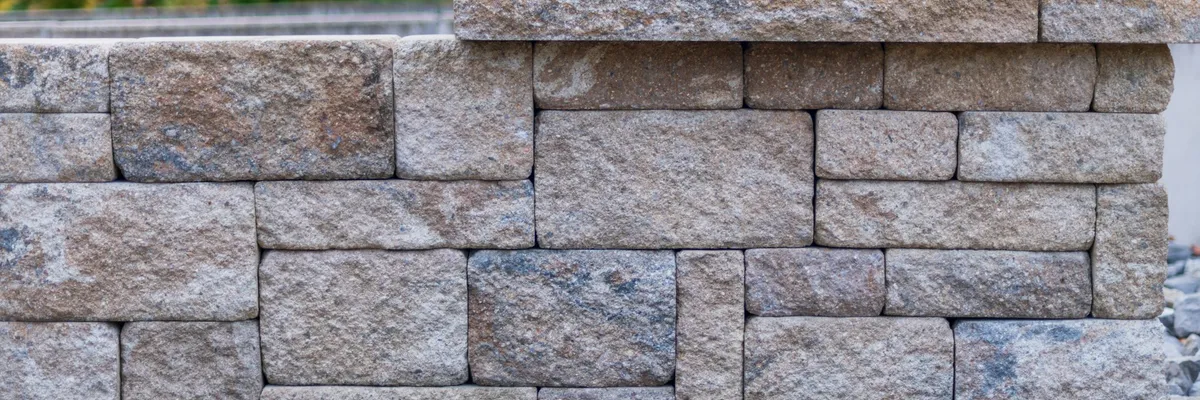
Use this retaining wall calculator to find how many blocks, cap blocks, base gravel, and drainage backfill your wall needs. Enter the wall length and height, pick your block size, and you get the full materials list with courses and rows worked out, plus 5% extra blocks for cuts.
1. Wall dimensions
Enter the height you want to see above ground — the buried base course is added automatically.
2. Base, drainage & waste — adjust defaults
3. Prices — optional, for a cost estimate
How to calculate wall blocks by hand
buried depth = exposed height ÷ 8   (minimum one full course)
total height = exposed height + buried depth
courses = total height ÷ block height
blocks per course = wall length ÷ block face width
total blocks = courses × blocks per course × 1.05
Worked example: a 30 ft wall with 2 ft of exposed height, using standard 12" × 4" face blocks. First the buried course: 24" ÷ 8 = 3" below grade, which rounds up to one full 4" course. Total height is therefore 28", not 24" — that is 7 courses, not 6. Per course: 360" ÷ 12" = 30 blocks. Total: 7 × 30 = 210, plus 5% waste → 221 blocks, plus 32 cap blocks.
That buried course is the step most block calculators skip. Leave it out and you arrive on install day one full course short — roughly 30 blocks in this example — because the wall has to start below grade to resist being pushed out at the base.
What goes into a retaining wall
| Component | Spec | Rule of thumb |
|---|---|---|
| Base trench | 24" wide, 6" crusher run | Compact in 2" lifts, dead level |
| Buried first course | 1" per 8" of wall height | A 32" wall buries ~4" |
| Drainage backfill | 12" of 3/4" clean gravel | Behind the full wall height |
| Drain pipe | 4" perforated, at base | Walls over 2 ft |
| Filter fabric | Between gravel and soil | Wrap over the top of the gravel |
| Setback (batter) | Lean into slope | Built into most block lips |
| Geogrid + engineering | Above 3–4 ft | Check local permit rules |
The two failure points of DIY walls are a sloppy base and no drainage. Water pressure behind the wall — not the soil itself — is what tips most residential walls, which is why the gravel backfill and drain pipe matter as much as the blocks.
FAQ
How many blocks do I need?
Total wall height (exposed + buried) ÷ block height, × length ÷ block face width, +5% waste. A 30 ft wall with 2 ft exposed and 12×4" blocks needs 7 courses ≈ 221 blocks plus 32 caps.
How deep should the base be?
6" of compacted crusher run in a 24"-wide trench, plus bury 1" of block per 8" of exposed height — always at least one full course.
Do I need gravel behind the wall?
Yes — 12" of clean 3/4" gravel, with a perforated drain pipe for walls over 2 ft.
How tall without an engineer?
Usually 3–4 ft max for gravity walls; taller needs geogrid and often a permit.
How heavy are the blocks?
Standard blocks 20–30 lbs; large formats 50–80 lbs. A 200-block wall is 3–6 tons — get it delivered.