
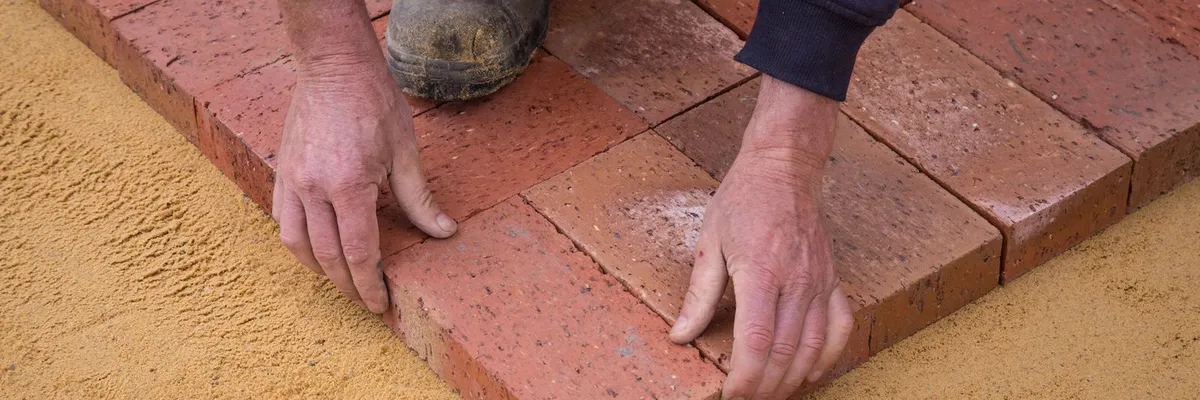
Use this paver calculator to find how many pavers, plus the gravel base, bedding sand, polymeric sand, and edging, you need for a patio, walkway, or driveway. Pick your laying pattern and it sets the right waste factor automatically — a 45° herringbone wastes nearly twice what a stack bond does. It also accounts for joint spacing, adds an optional soldier-course border, and tells you how much soil you are digging out.
1. Area
Area: 0 sq ft · Perimeter: 0 ft
2. Paver & pattern
The pattern sets your waste factor — a 45° herringbone means cutting almost every paver along the edges.
3. Joints, base & thickness — adjust defaults
4. Prices — optional
How to calculate pavers by hand
pavers = patio area (sq ft) ÷ paver area (sq ft) × 1.10
gravel base (yd³) = area × depth (ft) ÷ 27
Worked example: a 16 ft × 12 ft patio is 192 sq ft. A 4" × 8" paver covers 32 sq in = 0.222 sq ft, so 192 ÷ 0.222 = 864 pavers; add 10% for cuts → 951 pavers. The 4-inch base needs 192 × 0.333 ÷ 27 ≈ 2.4 cubic yards of gravel, and the 1-inch sand layer about 0.6 yd³.
Your pattern decides your waste factor
Most paver calculators ask you to type in a waste percentage — but almost nobody knows theirs. What you do know is the pattern you want, and the pattern is what determines how many pavers get cut:
| Pattern | Waste | Strength | Notes |
|---|---|---|---|
| Stack bond | 5% | Weakest | Aligned joints, modern look. Not for driveways |
| Running bond | 8% | Good | Half-offset rows, easiest to lay |
| Basket weave | 8% | Good | Needs 2:1 pavers such as 4″ × 8″ |
| Herringbone 90° | 12% | Strong | Interlocks, fewer edge cuts than 45° |
| Herringbone 45° | 15% | Strongest | The only pattern rated for vehicle traffic |
| Circular / fan | 20% | Varies | Every outer course needs cutting |
Select the pattern in the calculator above and the waste factor follows automatically. Order the extra in the same delivery — paver dye lots shift between production runs, so a top-up order weeks later rarely matches.
Joint spacing changes the count
Pavers are not laid edge to edge. A standard 1/8-inch joint means each 4″ × 8″ paver actually occupies 4.125″ × 8.125″ of space, so you need 4.3 pavers per square foot, not 4.5. Over a 200 sq ft patio that is about 40 pavers of difference — small enough to ignore on a small job, large enough to matter on a driveway.
Pavers per square foot by size
How many pavers per square foot?
From 4.5 for a standard 4×8 brick down to 0.25 for a 24×24 slab, depending on paver size. Divide 144 by the paver’s area in square inches to get the figure for any size. Those are edge-to-edge numbers; with a normal 1/8-inch joint the 4×8 count drops to about 4.3 per square foot, which the calculator above accounts for automatically.
| Paver size | Area each | Pavers per sq ft | Per 100 sq ft (+10%) |
|---|---|---|---|
| 4" × 8" | 32 sq in | 4.5 | 495 |
| 6" × 6" | 36 sq in | 4.0 | 440 |
| 6" × 9" | 54 sq in | 2.67 | 294 |
| 12" × 12" | 144 sq in | 1.0 | 110 |
| 16" × 16" | 256 sq in | 0.56 | 62 |
| 24" × 24" | 576 sq in | 0.25 | 28 |
The 12×12 row is the one most people ask about, because a 12-inch paver covers exactly one square foot — see how many pavers for a 12×12 patio for the worked count, base, and sand for that size.
The layers under a paver patio
How deep should the paver base be?
4 to 6 inches of compacted gravel for a patio or walkway, 8 to 12 inches for a driveway — measured after compaction, not loose. Go to the deep end of the range on clay soil or anywhere with hard freeze-thaw winters, since both push pavers up over time. The calculator sets 4 inches for patios and 10 for driveways by default.
Base depth is also a delivery question: the stone under a patio usually weighs about as much as the pavers on top of it. See how much a 12×12 paver weighs for per-piece, per-pallet, and per-square-foot figures.
A paver surface is only as good as what is underneath. From bottom to top: compacted soil, landscape fabric (optional but helpful on clay), 4–6 inches of compacted gravel base (crusher run or road base, compacted in 2-inch lifts), 1 inch of concrete bedding sand, then the pavers themselves with polymeric sand swept into the joints. Driveways need 8–12 inches of base instead.
Your total excavation depth = base depth + 1" sand + paver thickness (usually 2 3/8"). For a patio that is typically about 7–9 inches below finished grade.
FAQ
How many pavers per square foot?
4.5 for a 4×8 brick, 4.0 for 6×6, 1.0 for 12×12, 0.56 for 16×16, and 0.25 for a 24×24 slab — divide 144 by the paver’s area in square inches. Joint spacing lowers the count slightly.
How many 4×8 pavers per square foot?
4.5 per sq ft. A 100 sq ft patio needs ~450, or ~495 with 10% waste.
How deep should the base be?
4–6" compacted gravel for patios, 8–12" for driveways, plus 1" bedding sand.
How much sand under pavers?
1" of concrete sand ≈ 0.31 yd³ per 100 sq ft. Never use play sand.
Do I need polymeric sand?
Strongly recommended for joints — it hardens and blocks weeds, ants, and washout. One 50-lb bag does ~50–100 sq ft.
Can pavers go directly on dirt?
No — they will shift and sink within a season or two. The gravel base is what keeps them flat.