
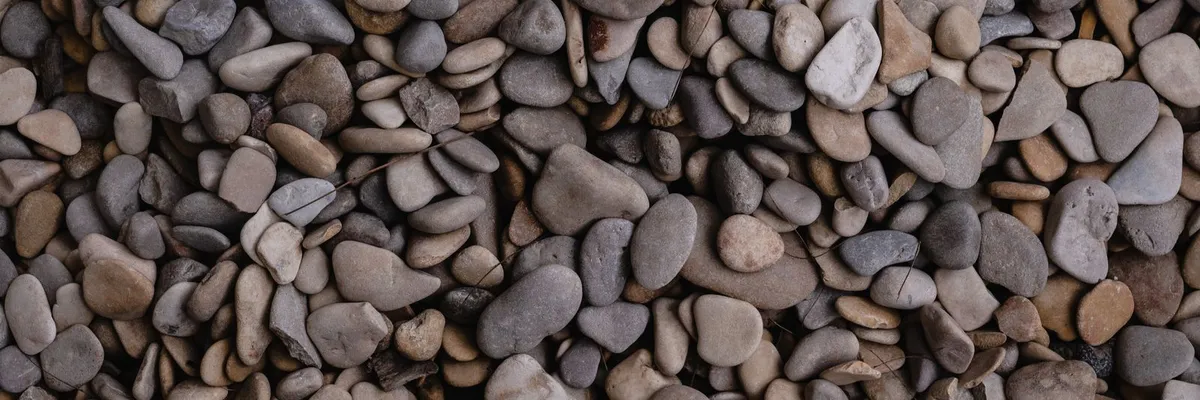
Use this river rock calculator to find how many cubic yards, tons, and bags of rock you need — whether your supplier lists it as river rock, landscape rock, or landscaping stone. It works two ways: straightforward area coverage for beds and borders, and a dry creek bed mode that accounts for the channel shape and the meander in the run — the two things that make a creek bed cost far less than a rectangle of the same footprint.
Area: 0 sq ft
Fabric, waste & prices — adjust defaults
How to calculate river rock by hand
River rock is sold by the cubic yard or by the ton, and the math takes two steps: find the volume, then convert to weight.
cubic yards = length (ft) × width (ft) × depth (ft) ÷ 27
tons = cubic yards × density (tons per cubic yard)
Worked example: a 20 ft × 10 ft bed at 3 inches deep. Convert depth to feet (3 ÷ 12 = 0.25 ft), multiply 20 × 10 × 0.25 = 50 cubic feet, divide by 27 = 1.85 cubic yards. At 1.30 tons per cubic yard for 1–2 inch rock, that is 1.85 × 1.30 ≈ 2.4 tons.
How many cubic yards in a ton of river rock?
One ton of river rock is about 0.71 to 0.83 cubic yards, depending on rock size. Smaller stone packs denser, so a ton of pea rock takes up less space than a ton of 4–8 inch cobbles. To get the figure for your size, divide 1 by the density:
| Rock size | Density (tons/yd³) | Cubic yards per ton |
|---|---|---|
| 3/8" pea-sized | 1.40 | 0.71 |
| 1"–2" small | 1.30 | 0.77 |
| 2"–4" medium | 1.25 | 0.80 |
| 4"–8" large | 1.20 | 0.83 |
So a 3-ton delivery of 1–2 inch river rock is about 2.3 cubic yards — enough to cover roughly 250 sq ft at 3 inches deep. Suppliers who quote by the ton usually round to the half ton, so ask which size class their density figure is based on before you compare prices.
Is river rock the same as landscape rock?
Not quite, and the difference matters for the math. River rock is naturally rounded stone, tumbled smooth by water, sold by size from 3/8-inch pea rock up to 8-inch cobbles. Landscape rock (or landscaping rock) is a broader catalogue term: it includes river rock, but also angular crushed stone, lava rock, and decorative gravel. This calculator uses river rock densities. If the product you are pricing is angular crushed stone, use the gravel calculator instead — crushed stone packs tighter and runs 10–15% heavier per yard, so the tonnage will be off if you treat it as river rock.
River rock weight and coverage by size
| Rock size | Density (tons/yd³) | Coverage per ton at 2" | Coverage per ton at 3" |
|---|---|---|---|
| 3/8" pea-sized | 1.40 | ~116 sq ft | ~77 sq ft |
| 1"–2" small | 1.30 | ~125 sq ft | ~83 sq ft |
| 2"–4" medium | 1.25 | — (lay 3"+ deep) | ~86 sq ft |
| 4"–8" large | 1.20 | — (lay 4"+ deep) | — (~68 sq ft at 4") |
Bulk density falls as stone size rises: bigger rounded stones leave bigger air gaps between them, so a yard of 4–8 inch rock weighs less than a yard of pea gravel even though each stone is heavier. Densities also vary between quarries — if your supplier publishes a tons-per-yard figure for the exact product, use theirs. For a full chart by size and depth, see how much a ton of river rock covers.
A dry creek bed is not a rectangular trench
Dry creek beds are the single most popular use for river rock, and the place where estimates go furthest wrong. Two things trip people up:
- The channel is deepest at the centre. A natural creek shallows out toward both banks, so its cross-section holds roughly a third less rock than length × width × depth implies. Multiplying the full depth across the full width overshoots badly.
- The run is longer than the distance it covers. A creek that meanders across 30 feet of yard is 34–39 feet of actual channel. Measure the straight-line run and let the calculator add the meander.
For a 30 ft run, 3 ft wide, 8 inches deep at the centre with gentle curves, the honest answer is about 1.9 cubic yards. Treat it as a square-cut trench and you would order 2.8 — nearly a full yard of the most expensive material on this site, sitting unused on your driveway.
Depth has to clear the stone size
You cannot lay 4–8 inch rock three inches deep. The layer has to be at least as deep as the largest stones or they sit proud, roll out of place, and leave soil showing between them. Match depth to size:
| Rock size | Minimum depth | Best for |
|---|---|---|
| 3/8″ pea-sized | 2″ | Paths, gaps between stepping stones |
| 1″–2″ small | 2–3″ | Ground cover, borders, tidy beds |
| 2″–4″ medium | 3–4″ | Creek beds, drainage swales |
| 4″–8″ large | 4–6″ | Erosion control, bank accents |
The calculator sets the right depth when you pick a size, and warns you if you override it with something shallower than the stones themselves.
How deep should river rock be?
Depth depends on rock size and purpose. For decorative ground cover with rock under 1 inch, 2 inches of depth hides the soil completely. For 1–3 inch rock, or anywhere you need durable coverage — borders, dry creek beds, drainage swales — plan on 3 to 4 inches. Very large rock (3 inches and up) needs a layer at least as deep as the largest stones, so 4 inches or more.
Going too shallow is the most common mistake: bare patches appear as rock shifts, and topping up later usually means paying a second delivery fee.
FAQ
How many cubic yards in a ton of river rock?
About 0.71–0.83 cubic yards, depending on size: 0.71 for pea rock, 0.77 for 1–2", 0.80 for 2–4", and 0.83 for 4–8" stone. Divide 1 by the tons-per-yard density.
Is river rock the same as landscape rock?
Not quite. River rock is rounded, water-tumbled stone. Landscape rock is a broader term that also covers angular crushed stone and decorative gravel. Use this calculator for rounded rock and the gravel calculator for crushed stone, which is 10–15% heavier per yard.
How much does a cubic yard of river rock weigh?
About 2,400–2,800 lbs (1.2–1.4 tons). Pea-sized runs ~1.40 tons/yd³; large 4–8" rock is lighter per yard at ~1.20 because bigger stones leave bigger gaps.
How many square feet does a ton cover?
Roughly 60–80 sq ft at 3 inches deep, or 90–120 sq ft at 2 inches. Coverage drops as rock size and depth increase.
How deep should river rock be?
2 inches for small decorative rock, 3–4 inches for larger rock or full soil coverage, and at least one rock-diameter for stones over 3 inches.
Do I need landscape fabric underneath?
Usually yes — it keeps rock from sinking and blocks weeds. Skip it only where drainage into the soil is the goal.
How many bags make a cubic yard?
54 bags at 0.5 cu ft each. Bulk is typically 30–50% cheaper once you need more than half a yard.