
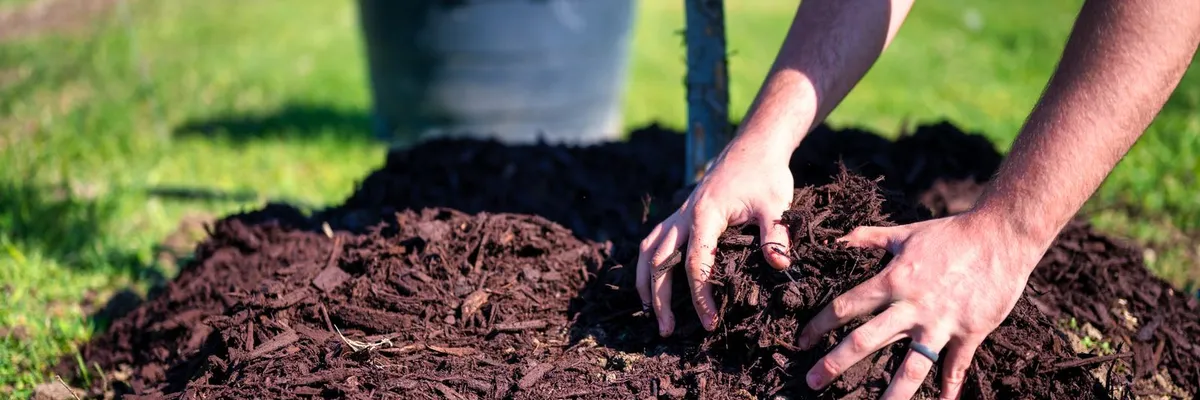
Use this mulch calculator to find how many cubic yards or bags of mulch you need. Add every bed you are mulching — rectangles, circles, and tree rings — and it totals them in one go. If you are refreshing beds that already have mulch, enter the existing depth and you will only buy the top-up you actually need.
1. Your beds
Mulching more than one bed? Add them all — most calculators make you do each one separately and add it up yourself.
2. Depth
Refreshing a bed? Enter what is already there — you only buy the difference, and it keeps you from burying your plants.
3. Mulch type & settling — adjust defaults
Fresh mulch settles 10–20% in the first few weeks.
4. Prices — optional, compares bagged vs bulk
How to calculate mulch by hand
Mulch is sold by the cubic yard (bulk delivery) or by the bag. The math is one formula:
cubic yards = length (ft) × width (ft) × depth (ft) ÷ 27
bags (2 cu ft) = cubic feet ÷ 2
Worked example: a 20 ft × 10 ft bed at 3 inches deep. Depth in feet is 3 ÷ 12 = 0.25. Volume is 20 × 10 × 0.25 = 50 cubic feet, which is 50 ÷ 27 ≈ 1.85 cubic yards — or 50 ÷ 2 = 25 bags of 2 cu ft mulch.
Refreshing beds? Only buy the difference
Most mulch calculators assume you are starting from bare soil. In reality most spring mulching is a top-up over last year’s layer that has broken down to an inch or two. If you already have 2 inches down and you want 3, you need 1 inch of new mulch — about a third of what a full 3-inch calculation would tell you to buy.
Getting this wrong is expensive twice over: you overspend, and you end up with a layer deeper than 4 inches, which traps moisture against stems and suffocates shallow roots. Measure what is already there with a trowel before you order, and enter it in the calculator above.
Mulch coverage chart
| Depth | 1 yard covers | 1 bag (2 cu ft) covers | Best for |
|---|---|---|---|
| 1" | 324 sq ft | 24 sq ft | Light top-up only |
| 2" | 162 sq ft | 12 sq ft | Annual refresh |
| 3" | 108 sq ft | 8 sq ft | New beds (recommended) |
| 4" | 81 sq ft | 6 sq ft | Weed suppression, max depth |
Bags per cubic yard
| Bag size | Bags per cubic yard | Common products |
|---|---|---|
| 1.5 cu ft | 18 | Premium hardwood, dyed mulch |
| 2 cu ft | 13.5 | Standard size at Home Depot, Lowe’s |
| 3 cu ft | 9 | Pine bark nuggets, economy mulch |
How deep should mulch be?
The sweet spot for most beds is 2 to 4 inches. Two inches is enough when refreshing existing mulch each spring; three inches is the standard for new beds and gives good weed suppression. Going past four inches does more harm than good — thick mulch layers hold moisture against stems, invite fungus and rot, and can suffocate shallow roots.
Keep mulch 2–3 inches away from tree trunks and plant stems. The “mulch volcano” piled against a trunk is the most common mulching mistake and a leading cause of bark rot in landscape trees.
FAQ
How many bags of mulch in a yard?
13.5 bags at 2 cu ft, 18 bags at 1.5 cu ft, or 9 bags at 3 cu ft — a yard is always 27 cubic feet.
How much does a yard of mulch cover?
324 sq ft at 1" deep, 162 sq ft at 2", 108 sq ft at 3", 81 sq ft at 4".
How deep should mulch be?
2–4 inches. Use 2" for refreshes, 3" for new beds. Never bury stems or trunks.
How much does a yard of mulch weigh?
Roughly 400–800 lbs depending on type and moisture. Most pickups can haul 2–3 yards.
Is bulk cheaper than bagged?
Above ~half a yard (7 bags), bulk is usually 30–50% cheaper per yard. Bags win on convenience and storage.